What role can organized labor play in shaping the future of healthcare for its members?
During a panel discussion, Mary Fogarty, National Taft-Hartley Liaison for Solidaritus Health, discussed how the organization is bringing labor ownership, healthcare delivery and union construction together through a new approach to primary care.
From its labor-funded structure to its plans for expanding across Long Island, Fogarty outlined how Solidaritus works with existing health plans, incorporates behavioral health into primary care, and partners with the building trades to develop healthcare facilities.
Mary Fogarty on the Future of Labor-Owned Healthcare
Watch the video below to learn more about the development of Solidaritus, the thinking behind its primary care model and the organization’s plans to bring additional healthcare resources to Long Island.
Keeping Healthcare Ownership and Decisions in Labor’s Hands
Labor involvement is central to how Solidaritus is funded, governed and developed. Solidaritus has 16 Taft-Hartley funds invested in it, along with wholly aligned investors. It has no private equity involvement, and its board is made up entirely of labor leaders, keeping decision-making in the hands of those who understand the needs of union members.
Fogarty illustrated this approach through the story of a physician who has spent 25 years serving union members at JFK Airport. Recognizing the potential of the Solidaritus model, the physician approached the organization about bringing a healthcare facility to the JFK workforce. The proposal was brought before the board and approved, setting the development of a new location in motion.
For Solidaritus, the connection between labor and healthcare extends beyond the boardroom, shaping how it serves union members and their communities.
Making Advanced Primary Care Work With Existing Coverage
Maintaining members’ existing healthcare coverage is another important part of their primary care model.
Fogarty explained that Solidaritus does not require plan design changes and is not a health maintenance organization (HMO). Members can continue seeing doctors within their current health plan, with their existing coverage remaining unchanged.
That flexibility also extends to funds that have already established other healthcare arrangements. Fogarty specifically mentioned conversations with local unions using Northwell Direct to generate savings. When asked whether Solidaritus could work alongside those arrangements, her answer was straightforward: yes.
Rather than replacing existing strategies, Solidaritus aims to complement them and help funds identify additional opportunities to reduce healthcare spending.
Making Behavioral Health Part of Whole-Person Care
Drawing on her background in behavioral health within the trades, Fogarty wanted to ensure these services were included in the Solidaritus primary care model rather than treated as a separate part of healthcare.
“If you’re offering whole-person care, that needs to include behavioral health,” she explained.
To put this into practice, Solidaritus has incorporated a behavioral health assessment into its primary care visits, giving members an opportunity to address behavioral health needs as part of their regular healthcare experience. The organization also works with a behavioral health provider network that can offer additional services and continued support when further attention is needed.
By including both an initial assessment and access to a broader network of providers, the model creates a more connected approach to addressing members’ physical and mental well-being.
Measuring the Impact on Healthcare Spending
Alongside its approach to labor ownership and healthcare delivery, Solidaritus has also reported measurable savings among its existing customers.
Over the past seven years, Solidaritus has helped its customers achieve savings ranging from 5% to 23% in healthcare spending. Fogarty also pointed to the organization’s first customer, which has remained with Solidaritus since 2017 and continues to see double-digit savings.
These savings are driven in part by a focus on accessible, proactive primary care rather than limiting services. Members have access to same-day or next-day appointments, with visits averaging approximately 45 minutes with their personal physician. Through these visits, members can develop personal health action plans in partnership with their physician, helping address health needs proactively and potentially avoid costly downstream care.
Several aspects of Solidaritus’ care model contribute to healthcare cost savings, including:
- Efficient primary care delivery: Improving how primary care services are delivered and coordinated.
- Avoiding urgent care and emergency room visits: Addressing health concerns earlier to reduce reliance on emergency services.
- Laboratory tests and prescriptions: Identifying opportunities for savings on diagnostic testing and medications.
- Specialty referrals and downstream care: Coordinating referrals and helping members access appropriate services when additional care is needed.
- Wellness, prevention and disease management: Supporting members in managing existing conditions and taking proactive steps to maintain their health.
Together, these strategies reflect Solidaritus’ approach to improving the quality of care while helping labor funds manage rising healthcare costs.
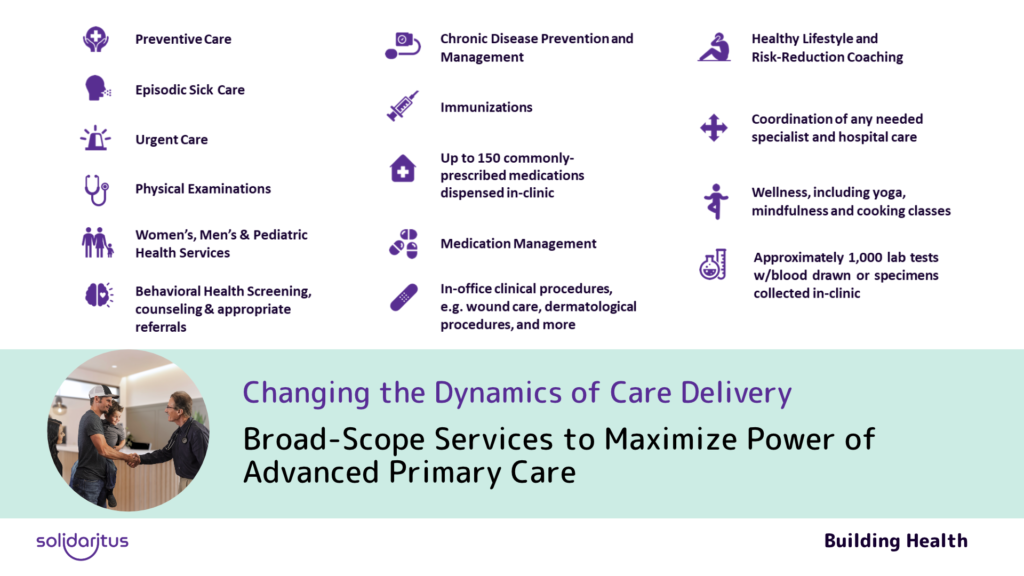
Overview of the services offered through the Solidaritus primary care model, including preventive care, behavioral health, chronic disease management, and specialty care coordination.
Expanding Healthcare Facilities Through Union Construction
Solidaritus’ approach also extends beyond healthcare delivery to the construction of its facilities.
As part of its regional expansion, the organization is working with several Long Island locals that will serve as founding partners in the buildout. Fogarty estimated that the network could include approximately 40 to 50 centers over the next year or so.
Initial locations under consideration include Ronkonkoma, Melville, Shirley and several sites in Nassau County, in addition to the JFK facility currently under development.
A defining part of this expansion is the commitment to union construction. Fogarty stated that every Solidaritus center will be 100% labor-built through a project labor agreement (PLA), regardless of the project’s size.
Through these projects, the building trades will have a direct role in bringing Solidaritus’ healthcare expansion to life.
Continuing the Conversation About Labor-Owned Healthcare
Solidaritus’ approach brings together labor leadership, primary care, behavioral health and union construction to create a healthcare model shaped by the needs of the communities it serves. From its labor-led governance structure to its plans for expanding union-built healthcare centers, the organization is working to give labor a more direct role in shaping healthcare services for its members.
For union leaders, exploring new approaches to primary care, managing healthcare costs and expanding access to services remains an important part of supporting their membership. As healthcare needs and costs continue to change, labor’s involvement in shaping these solutions will remain an important part of the conversation.
At ULA Network, we believe that highlighting initiatives like these is essential to supporting, educating and promoting union labor. To learn more about Solidaritus, visit https://ulanetwork.com/supporters-ula-network/solidaritus/.
Frequently Asked Questions About Solidaritus Health
1. Is Solidaritus Health owned and funded by labor?
Solidaritus is 100% labor-funded, with 16 Taft-Hartley funds invested in the organization or wholly aligned investors. Fogarty explained that the organization has no private equity involvement and is governed by a board made up of labor leaders.
2. Do union health funds need to change their plan design to work with Solidaritus?
No. Solidaritus works alongside existing health plans without requiring changes to plan design. Members can continue seeing doctors within their current networks, and their coverage remains the same.
3. Does Solidaritus include behavioral health services?
Yes. Fogarty explained that Solidaritus incorporates a behavioral health assessment into its primary care visits, with a behavioral health network available to support additional services and follow-up care.
4. How much has Solidaritus saved its customers on healthcare spending?
Fogarty reported savings of between 5% and 23% in overall healthcare spending across Solidaritus’ existing customers over the past seven years. She also noted that its first customer, which began working with the organization in 2017, continues to see a double-digit decrease in overall healthcare spending.
5. Will Solidaritus healthcare centers be built with union labor?
Yes. Every Solidaritus facility will be 100% labor-built through a project labor agreement, regardless of the size of the project. The organization is working with Long Island locals on its regional expansion.