
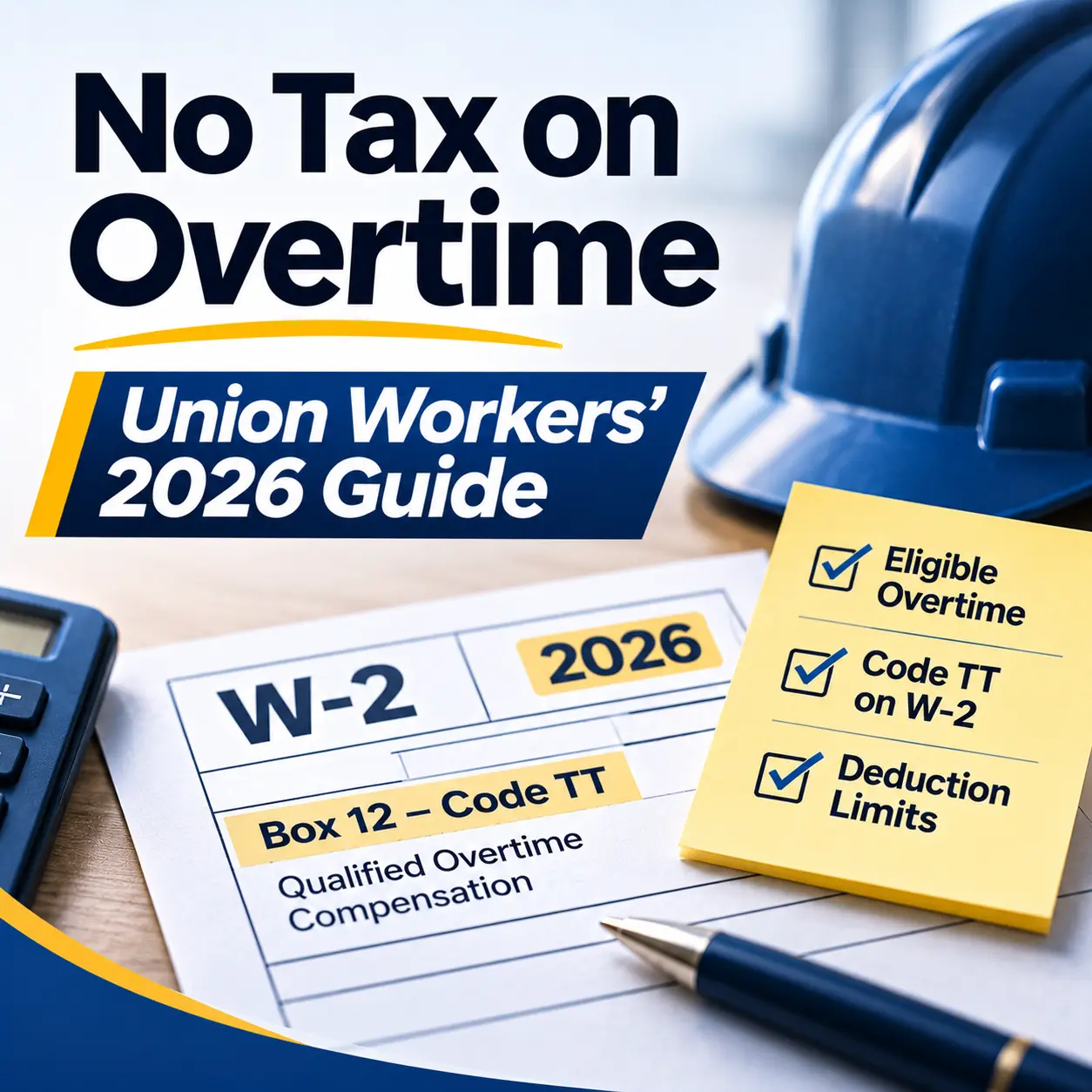
Did you work long weeks this year and expect the new overtime deduction to cover every overtime dollar on your paycheck? Many union tradespeople will find that the rule is narrower than its name suggests. Under the One, Big, Beautiful Bill Act, the deduction covers only part of overtime pay. For 2026 wages, the amount you can claim also depends on one number your employer reports on your Form W-2.
The IRS released its updated frequently asked questions on August 6, 2026, and the changes matter for anyone paid under a collective bargaining agreement. Starting with tax year 2026, you can deduct only the qualified overtime compensation that your employer reports. That amount appears in box 12 of Form W-2 with code TT. At ULA Network, we want every member to understand which overtime earnings qualify for the new tax deduction and how much they may be able to claim. This can help you review your tax forms carefully and address any errors before filing.
How Much No Tax on Overtime Union Workers Can Claim
The overtime break is a federal income tax deduction, not a tax exemption. Your overtime earnings generally remain subject to federal income tax withholding, Social Security and Medicare taxes. The benefit comes when you file your return and claim the deduction on Schedule 1-A (Form 1040).
The IRS overtime deduction rules set these limits:
- Maximum deduction: You can deduct up to $12,500 of qualified overtime compensation, or $25,000 if you file a joint return.
- Income phase-out: The deduction begins to decrease when modified adjusted gross income (MAGI) exceeds $150,000, or $300,000 for joint filers. It is reduced by $100 for each $1,000 of income above the applicable threshold.
Because this is a deduction, your actual savings depend on your tax bracket. For example, if a member in the 22% bracket deducts $6,000 of qualified overtime, federal income tax drops by about $1,320. State and local income taxes follow their own rules. Before counting on a state-level break, check how your state treats overtime pay.
Why Union Contract Overtime Does Not Fully Qualify
Only overtime required under section 7 of the Fair Labor Standards Act (FLSA) qualifies for the deduction. Union membership does not decide eligibility, because what matters is whether you are an FLSA overtime-eligible (nonexempt) employee. In general, the FLSA requires time-and-a-half for hours over 40 in a workweek, and only the “half” premium counts. Overtime paid under a collective bargaining agreement or state law qualifies only to the extent the FLSA also requires it. The IRS confirms this limit in its updated frequently asked questions.
This rule affects many common contract terms:
- Double time: When an employer pays double time for hours over 40 in a workweek, only the FLSA-required half-time premium qualifies for the deduction. The additional half-time premium paid under the contract does not qualify.
- Daily, weekend and holiday overtime: Many contracts pay premiums for hours beyond eight in a day or for Saturday, Sunday and holiday work. These premiums count only for hours that are also over 40 in the workweek, and then only up to the FLSA half-time amount.
- Shift differentials: These premiums are not deductible overtime by themselves. Under the FLSA, though, they are generally included in your regular rate of pay. As a result, they raise the value of each qualifying half-time hour.
Here is how that works on a jobsite:
A journeyman earning $50 an hour works 50 hours in one workweek with no other pay. The contract pays double time for the 10 extra hours, so the member receives $1,000 for those hours. The qualified overtime compensation, however, is only $250, which is 10 hours × ½ × $50.
It is also important to note that premium pay won through collective bargaining still raises your take-home pay, even when the tax code recognizes only part of it. Understanding which portions of your overtime qualify can help you make sense of your paycheck, review your tax documents and know what to expect when filing your return. At ULA Network, we continue to share resources that help members understand how their contract terms affect each paycheck. To learn more, visit our financial resource page.
Code TT on Your 2026 W-2
For 2026 wages, employers must report total qualified overtime compensation in box 12 of Form W-2, using Code TT. For 2025, the IRS gave transition relief, so many members calculated their overtime themselves. According to the IRS updated frequently asked questions, no relief is available for tax years after 2025.
The code TT amount sets the ceiling on what you can deduct. For that reason, review it as soon as your W-2 arrives.
Before you file your return, check these points:
- Multiple employers: Tradespeople who move between signatory contractors may receive several W-2s, and each one should show its own code TT amount.
- Missing or low amount: If code TT is missing or too low, ask the employer for a corrected Form W-2c. Without that correction, you can deduct only the amount reported.
If an employer did not pay the overtime the FLSA requires, that is a wage issue, not only a tax issue. If you have questions about unpaid overtime or your legal options, the following resources may help:
- Wage Violation Claims: Hach Rose Schirripa & Rehns LLP handles wage violation claims when employers fail to provide proper overtime pay.
- Group and Prepaid Legal Plans: Feldman, Kramer & Monaco, P.C. serves members through group and prepaid legal plans offered by unions and benefit funds. If your benefit fund offers one of these plans, you can raise related legal questions through it.
For additional support, explore ULA Network’s legal resources to find more sponsor contacts.
How to Get the Benefit Sooner With Form W-4
Overtime remains subject to federal income tax withholding, so the savings usually arrive as a larger refund or a smaller balance due. If you prefer more money in each paycheck, you can give your employer a new Form W-4 that estimates the deduction in Step 4(b). The IRS explains this option in its updated FAQs.
If a larger refund does arrive, these smart money moves can help you put it to work. The Monthly Budget Calculator in our financial resources for union members also shows how overtime pay fits into your monthly plan.
Get Ready for W-2 Season With ULA Network
How much union workers can claim under the no tax on overtime deduction depends on accurate records and proper reporting. Only the FLSA half-time premium counts, and contract premiums such as double time count only up to that amount. For 2026, the code TT figure on your W-2 sets the limit. Keep your pay stubs, check every W-2 you receive, and request a Form W-2c as soon as possible if something is wrong.
ULA Network supports union members and their families with clear, practical education on pay, benefits and money decisions. Explore our financial literacy programs, and share this information with your local before W-2 season begins.
| In partnership with Hach Rose Schirripa & Rehns LLPHach Rose Schirripa & Rehns LLP supports ULA Network in helping the labor community understand employment rights, ERISA protections and other legal matters affecting workers across New York. The firm represents employees, union members and benefit funds in matters such as wage and hour violations, discrimination, retaliation and fiduciary breach.Learn More About Hach Rose Schirripa & Rehns LLP |
No Tax on Overtime FAQs
1. Is Union Overtime Tax-Free Under the New Law?
No, union overtime is not tax-free. Only the FLSA-required half-time premium for hours over 40 in a workweek is deductible. All overtime pay also remains subject to Social Security and Medicare taxes.
2. Are Rail and Airline Union Members Eligible for the Overtime Deduction?
Generally, no. The FLSA overtime requirement does not apply to railroad and air carrier employees, so their contract overtime does not qualify. The proposed No Tax on Overtime for All Workers Act (S. 4310) would expand eligibility, but it is not yet law.
3. What If Code TT Is Missing From My W-2?
Ask your employer for a corrected Form W-2c that reports the amount in box 12 with code TT. For tax years after 2025, the IRS does not allow a deduction for qualified overtime that is not reported on a W-2.
4. Can Married Union Members File Separately and Still Claim It?
No, married employees must file a joint return to claim the deduction. If both spouses received qualified overtime compensation, both also need valid Social Security numbers on the return.
5. How Long Will No Tax on Overtime Last?
Under current law, the deduction applies to tax years 2025 through 2028. It will end after 2028 unless Congress extends it.