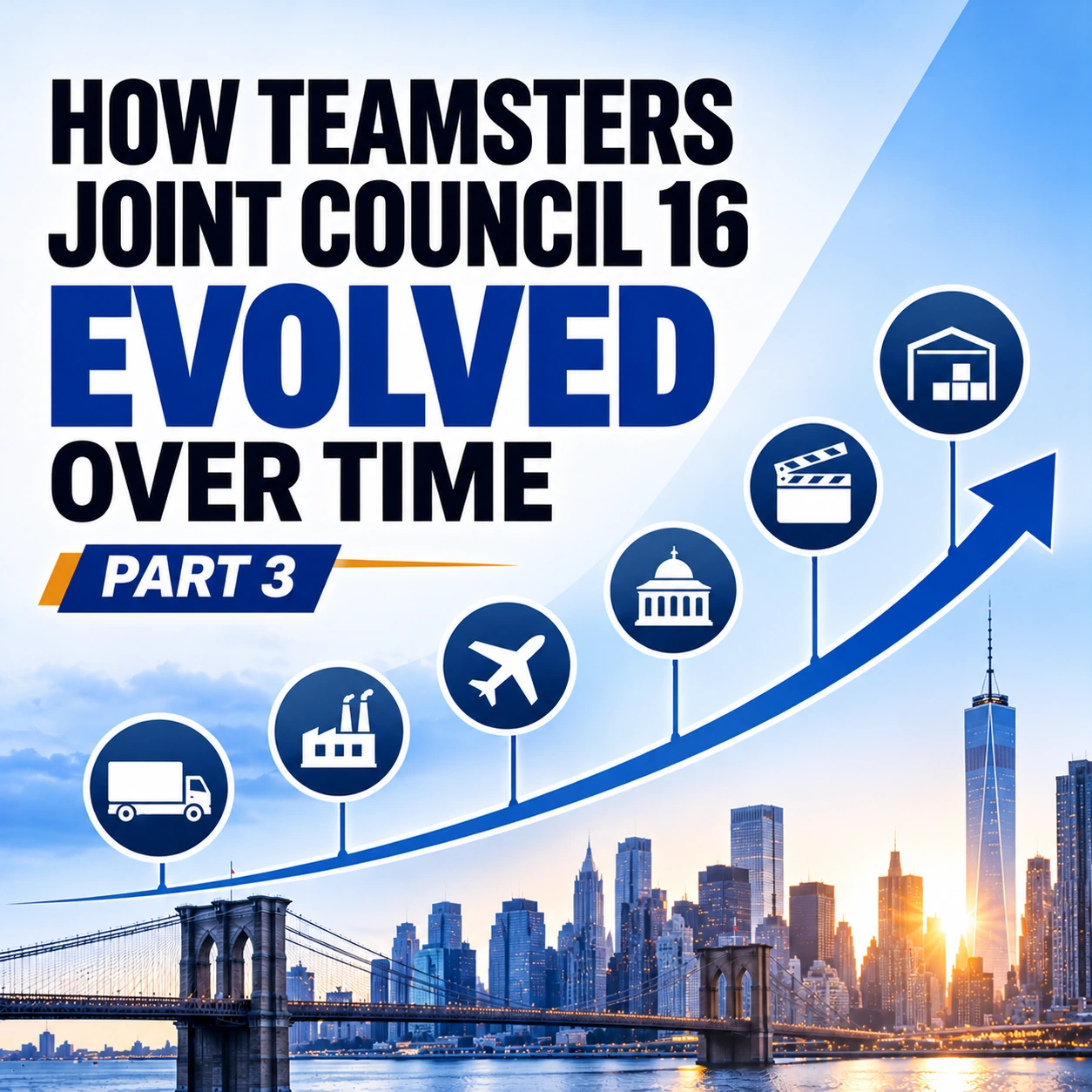
Teamsters Joint Council 16 represents workers in trucking, public service, warehouses, airports, film, and printing. Over generations, local unions expanded the council’s membership into new industries. Today, its 26 locals represent 120,000 workers across downstate New York and Puerto Rico.
This expansion beyond trucking began long before the Motor Carrier Act of 1980 changed the freight industry. Understanding that timeline helps explain the range of trades within the council today.
National earnings data provides broader context for union representation. The U.S. Bureau of Labor Statistics reports 2025 median usual weekly earnings of $1,404 for full-time union members, compared with $1,174 for nonunion workers. The two groups differ in occupation, industry, and other characteristics, so these figures do not measure the pay difference between otherwise identical jobs.
Trucking Deregulation and the Motor Carrier Act of 1980
The Motor Carrier Act of 1980 eased federal controls over trucking rates and market entry. More firms could compete for loads, which placed pressure on freight prices, established carriers, and union trucking jobs.
In 1983, the U.S. GAO reviewed Teamster findings that described prolonged layoffs among drivers with seniority rights.
An economic slowdown added to the pressure as some firms failed and more carriers competed for freight. Established union carriers faced competition from lower-cost firms, while many drivers with seniority remained on layoff.
The study did not establish how many laid-off drivers later found other employment. Its findings therefore do not show whether all affected drivers remained unemployed over the longer term.
How Changes in New York Work Shaped Membership
As employment shifted across New York industries, Teamsters organized workers in new fields while continuing to address pay, safety, scheduling, and workplace conditions.
- When factories closed or moved, workers lost jobs that had long operated under union contracts.
- As supply chains changed, warehouse workers took on a growing role in storing and distributing goods.
- Growing city services created more union jobs in sanitation, housing, and other public work.
- Expanding air travel created work in airline and fueling operations at New York airports.
- Film, TV, and live events needed crews and drivers with work rules suited to those industries.
The dates when these groups joined show that expansion beyond trucking developed over several decades.
Expansion Beyond Trucking Into Other Industries
Public Sector Members and Sanitation Workers
Public service has long been part of Teamster work in New York. City sanitation workers joined in 1951 and formed Local 831, while Local 237 grew to represent workers in New York City public housing.
In 1971, public sector members joined a citywide strike over a pension dispute. Local 237 bridge operators raised and locked bridge crossings to press state lawmakers to act on the pension agreement that workers had reached with the city.
Warehouse, Airline, and Beverage Workers
In 1948, 1,000 Macy’s warehouse workers voted to join Local 804. Although the local later became well known for package delivery, warehouse work remains an important part of its history.
Local 553 members run JFK’s fueling operation, while Local 812 represents beverage workers. These locals represent distinct industries, each with its own duties and contract requirements.
Film Industry Workers, Newspaper Printers, and Event Crews
Joint Council 16 also includes film industry workers, newspaper printers, manufacturers, and construction workers. In addition, Local 553 represents convention crews at the Jacob Javits Center and other New York event spaces.
At ULA Network, we share stories from across these trades through union interviews and coverage. Members can learn about the duties, workplace concerns, and organizing experiences of others in the labor community.
Civil Rights, Worker Protection, and Union Culture
New York Teamsters have also supported struggles that reached beyond their immediate workplaces. Local 810 members joined the 1963 March on Washington for Jobs and Freedom. Other Teamsters sent trucks, supplies, money, and organizers to support civil rights work in the South.
Laws Addressing Driver Status and Warehouse Safety
After years of Teamster support, New York enacted its Commercial Goods Transportation Industry Fair Play Act in 2014. The law establishes criteria for determining whether commercial drivers qualify as employees or independent contractors. These criteria help determine whether drivers are employees entitled to applicable wage, benefit, and workplace protections.
New York followed with the Warehouse Worker Injury Reduction Act in December 2024, and its rules took effect on June 1, 2025. Covered employers must identify injury risks, take steps to reduce them, and train workers on tasks such as lifting.
If driver classification or warehouse safety affects your job, learn how New York labor laws apply and speak with your union. Ask which provisions cover your employer and the work you perform, since eligibility and employer obligations differ by law.
Joint Council 16 Membership and Structure Today
The council links 26 locals within the International Brotherhood of Teamsters. Across the U.S., Canada, and Puerto Rico, the wider union has more than 1.4 million active members. Some deliver for Coca-Cola, Entenmann’s, UPS, and Frito-Lay, while others work in factories, airports, warehouses, public housing, and sanitation.
| Area of work | Examples within Joint Council 16 |
| Construction and building materials | Local 282 in New York City and Long Island |
| Sanitation and public service | Local 831 and Local 237 |
| Package delivery and warehousing | Local 804 and Local 553 |
| Airline and fuel operations | Local 553 members at JFK |
| Film, printing, and events | Local 817, Local 2N, and Javits Center crews |
National Contracts and Member Benefits
Although locals handle daily representation, their members may also work under national contracts. The International Brotherhood of Teamsters reported an 86.3% yes vote on the 2023 UPS contract.
The agreement covered more than 340,000 workers when the vote took place in 2023. It established pay and work rules under North America’s largest private-sector collective bargaining agreement.
Health and retirement benefits also form part of many union compensation packages. Trustees of Teamster benefit funds oversee the plans they serve. Contact your fund for information about your plan’s eligibility rules, coverage, and benefits.
Union Opportunities for the Next Generation
Although Teamster jobs have changed over time, members continue to organize for fair wages, safer workplaces, and better working conditions.Members still join forces to seek fair pay, safer workplaces, and enough time with their families.
If you want to learn a trade, apprenticeship opportunities in New York provide a practical route to explore. Because every program has its own entry rules, review the current requirements before applying.
Preserving the history of local unions helps future generations understand how these organizations and the workers they represent have shaped New York’s workforce. ULA Network helps locals share those stories through blogs, interviews, and videos. If your local has a history or milestone worth documenting, explore our partnership opportunities or contact our team.
Frequently Asked Questions About Teamster Evolution
1. How did trucking deregulation affect Teamster members?
It made it easier for new firms to enter the market and compete for freight. Established union carriers faced stronger cost pressure, while many drivers with seniority rights experienced long layoffs.
2. What industries do Teamsters work in today?
Their work spans freight, construction, sanitation, public housing, warehouses, airports, food, beverages, printing, film, and events. The national union describes itself as America’s most diverse union, reflecting the range of occupations its members hold.
3. How many locals does Joint Council 16 have now?
The council currently lists 26 locals representing 120,000 workers. Mergers between locals help explain part of the decline from 61 locals in 1960.
4. Are public employees part of the Teamsters in New York?
Yes. Local 831 represents sanitation workers, while Local 237 represents workers in public housing and other public services. Such jobs have been part of New York Teamster history since its early years.
5. What is the largest Teamster contract in the country?
The UPS National Master Agreement covered more than 340,000 workers when members voted in 2023. It passed with 86.3% support and stands as North America’s largest private-sector collective bargaining agreement.