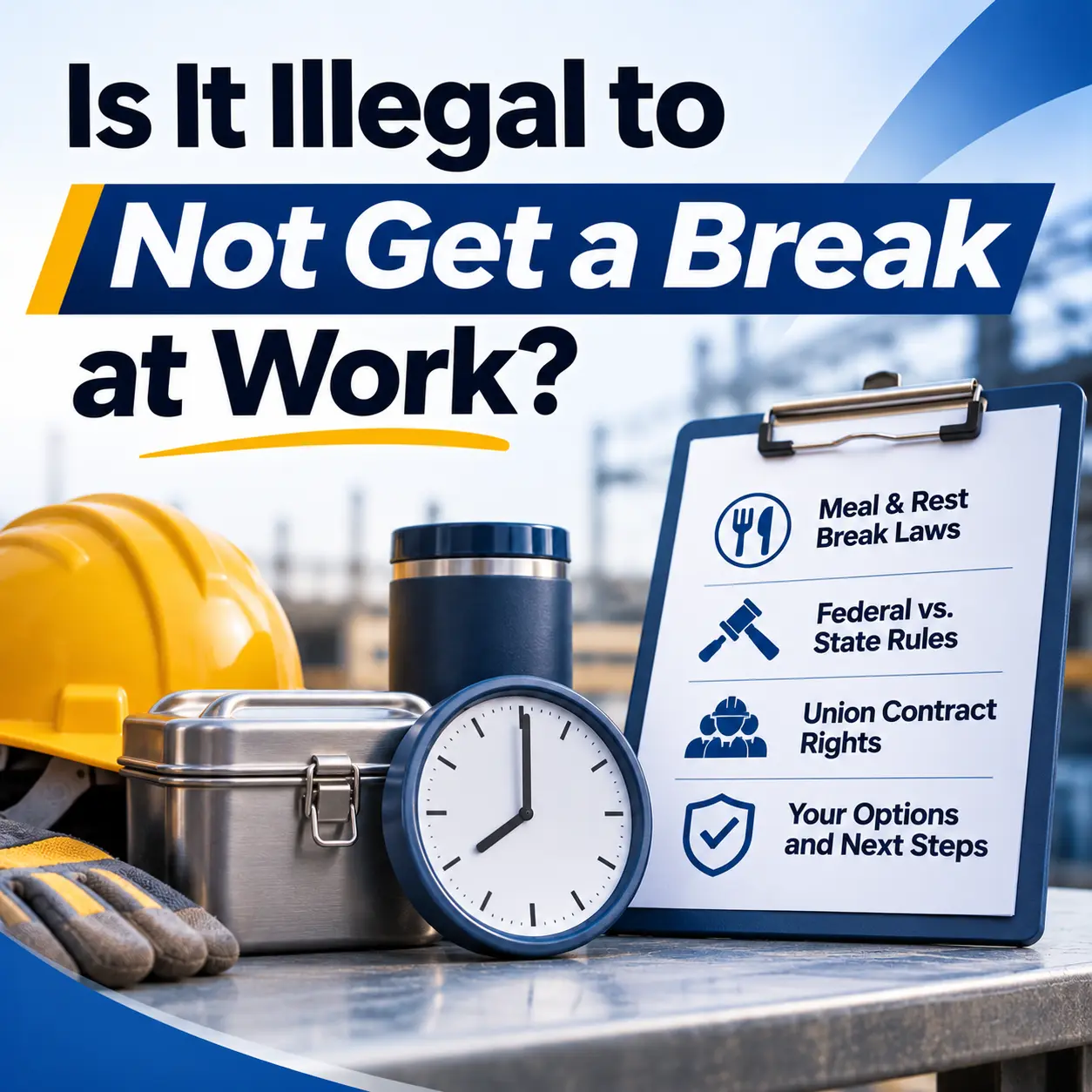
You finish a 10-hour shift without a meal break and wonder whether your employer can legally require it. Under federal law alone, it is not illegal for an adult to work without a meal break or rest break. However, state law, local rules, or a union contract may give you stronger rights.
The Fair Labor Standards Act (FLSA) does not require a break at work for adult employees. Instead, it decides when break time counts as paid hours worked. In fiscal year 2025, the Wage and Hour Division recovered more than $259 million in back wages. The U.S. Department of Labor says that recovery covered nearly 177,000 workers and averaged $1,465 each. Those figures include several wage violations, so they do not measure break claims alone.
This guide explains how federal law, state requirements, and union contracts affect your right to breaks at work.
Federal Break Law Covers Pay, Not Whether You Get One
Federal law generally does not require employers to provide adult workers with meal or rest breaks. When an employer provides breaks, the U.S. Department of Labor’s Fact Sheet #22 explains when that time must be paid:
- Short rest periods, usually lasting 20 minutes or less, count as paid hours worked.
- A meal period, often lasting at least 30 minutes, may be unpaid only if you stop all work duties.
- If you answer calls, monitor equipment, or perform other work duties during a meal period, that time generally must be paid. Eating at your workstation does not by itself determine whether the break is compensable.
- When you extend an authorized break, the extra time may be unpaid if your employer clearly gave the limit and explained the consequences.
Is It Illegal to Not Get a Break at Work in Your State?
Whether your employer must provide a break depends partly on the state where you work. The U.S. Department of Labor’s chart lists 21 states or other jurisdictions with meal period requirements for some adult employees. It identifies 7 states that also require a paid rest break: California, Colorado, Kentucky, Minnesota, Nevada, Oregon, and Washington. Since exceptions differ, check your job and industry.
| Who sets the rule | What it covers | Where to check it |
| Federal FLSA | Whether break time counts as work and requires pay. | U.S. Department of Labor. |
| State law | Whether a break is required, when it starts, and who qualifies. | Your state labor department. |
| Union contract | Break length, timing, pay, and enforcement. | Your steward or contract book. |
Meal Period Rules Under New York Labor Law
New York bases meal rights on a shift’s length and timing. Many employees are entitled to a meal period when their shift meets specific length and timing requirements, but the rules differ by type of work.
- Factory workers receive a 60-minute noonday meal period.
- Other employees working more than 6 hours across the 11 a.m. to 2 p.m. window receive at least 30 minutes during that period.
- A shift starting before 11 a.m. and continuing after 7 p.m. includes another 20-minute meal period between 5 p.m. and 7 p.m.
- A shift of more than 6 hours starting between 1 p.m. and 6 a.m. includes 60 minutes in a factory or 45 minutes elsewhere, usually near the middle.
Exceptions and authorized shorter meal periods may apply. Check the New York State Department of Labor’s guidance to determine which rules cover your job.
How Long Can You Work Without a Lunch Break?
Federal law sets no general maximum for how long an adult can work without a lunch break. In many states, an employer can schedule a full shift without one. A state or local rule, industry rule, or union contract can change that result. If the rules feel unclear, start with your rights as an employee, then check the law where you work.
A Union Contract May Provide Stronger Break Rights
A union contract can establish specific break requirements that go beyond the protections provided by law.. The contract can set a clear right and support it with a grievance process when management ignores the language. This is one way collective bargaining improves wages and working conditions.
- Some agreements provide a paid break of 15 minutes during each half of the shift.
- Others require premium pay if a foreman makes employees work through the meal period.
- Some contracts specify when meal periods must occur, limiting management’s ability to reschedule them.
Because every agreement differs, read the clause before filing a grievance. Your steward can help with records and deadlines. Our legal resources explain contracts and workers’ rights. Members can also study with The Labor Guild, which has trained the labor community since 1945. Locals using the Union Strong App can send contract updates across jobsites.
Break Rights That Apply Across the United States
Some workplace rights come from rules outside ordinary break law.
- OSHA sanitation standards require employers to provide drinking water and toilet facilities. OSHA also expects employers to allow employees prompt access to restroom facilities when needed, as our guide to what OSHA is explains.
- Under the PUMP Act, most covered nursing employees are entitled to reasonable break time as needed to express breast milk for up to one year after their child’s birth. Employers must also provide a private space that is shielded from view, free from intrusion, and not a bathroom.
- Federal heat rest-break requirements remain proposed, not final. The Occupational Safety and Health Administration ended its hearing on July 2, 2025. Later, the comment period closed on October 30, 2025. State heat rules may still apply.
What to Do When Breaks Keep Disappearing
Keeping accurate records of missed breaks and hours worked can help support a wage complaint or grievance. If missed breaks have become a pattern, take these steps:
- Write your start time, break time, and stop time in a notebook each day.
- Keep a lawful copy or photo of the sign-in sheet or manpower report, but do not copy restricted records.
- Check each pay stub for an automatic 30-minute lunch deduction on a day when you worked through lunch.
- Report the pattern to your steward in writing, follow the grievance deadline, and call the Wage and Hour Division at 1-866-487-9243.
- Review your rights under New York labor laws before a New York meeting or complaint.
If your benefit fund offers a group or prepaid legal plan, you can raise wage questions through a plan firm such as Feldman, Kramer & Monaco, P.C.. When an employer requires employees to work through meal and rest breaks without pay, Hach Rose Schirripa & Rehns LLP handles wage violation claims, including class actions. If a long shift without rest leads to a workplace injury, Schwartzapfel Holbrook represents injured workers in workers’ compensation and construction accident cases across New York.
Walk Into Your Next Shift With Clear Information
Break requirements can be confusing because federal law, state law, and union contracts may provide different protections. Federal law decides when break time requires pay. State law may require the break itself, while a collective bargaining agreement can improve timing, pay, and enforcement. Review all three sources to understand your rights if you’re scheduled for a long shift without a meal break or notice an unexplained deduction from your pay.
Our network keeps this education free for locals, apprentices, and families. If your local needs it for a meeting or member mailer, contact us today.
Frequently Asked Questions
1. Does My Employer Have to Pay Me for a 15-Minute Break?
Generally, yes. Under federal law, short rest breaks of 20 minutes or less must be paid when provided. For covered, nonexempt employees, this time also counts toward the hours used to calculate overtime.
2. Can My Employer Make Me Stay on the Jobsite During Lunch?
Often, yes. Staying on the jobsite does not make lunch paid. However, the meal period generally counts as work if you perform duties or are not completely relieved from duty.
3. Can I Face Discipline for Taking a Break My Contract Allows?
The discipline may violate your union contract. Tell your steward that day, keep every notice, and meet the grievance deadline.
4. What If My Check Shows a Lunch Deduction I Never Took?
That deduction may create unpaid wages if you worked during the deducted time. Save the pay stub, record your real hours, and report the problem in writing.
5. Do Break Rules Cover Apprentices the Same Way?
An apprentice generally receives the same federal wage and hour protections as a covered journey-level worker. However, contract break terms can differ, so check both agreements with your steward.