A fall from a scaffold can turn your family’s life upside down. As medical bills arrive and missed paychecks add up, you may wonder whether workers’ compensation, a personal injury claim, or both could apply.
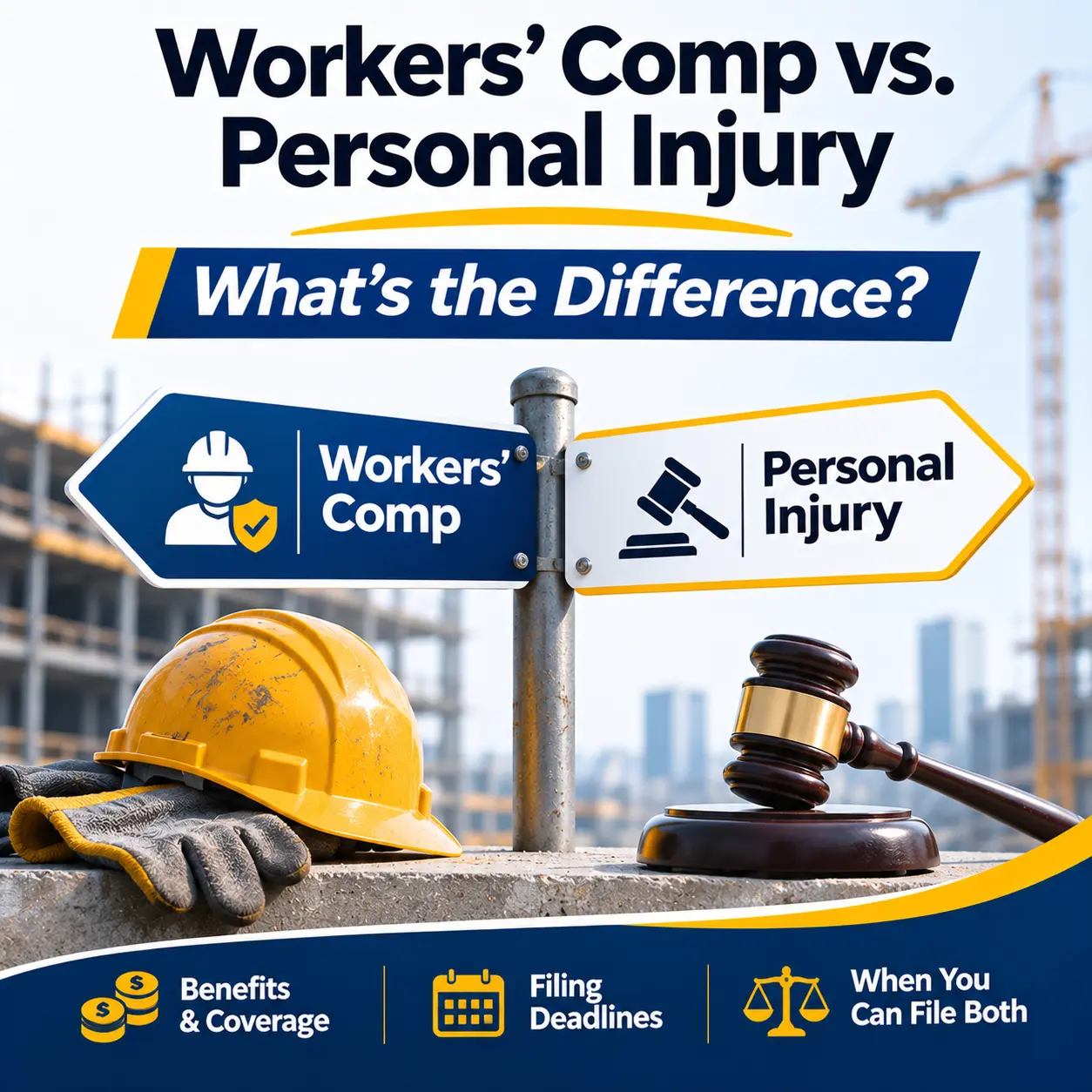
The workers’ comp vs. personal injury difference comes down to fault and which losses each claim covers. Workers’ comp pays for medical care and part of your wages, so you do not need to prove fault. Most personal injury claims need proof that someone else caused harm through negligence. If you prove the claim, it can also pay for pain and suffering.
According to the Bureau of Labor Statistics, private employers reported 2.5 million nonfatal workplace injuries and illnesses in 2024. Behind those cases are workers who need care and, if they miss work, help with lost income.
What Workers’ Comp Covers in New York
Workers’ compensation is no-fault insurance that generally covers eligible injuries and illnesses arising out of and in the course of employment. You do not need to prove that your employer was negligent to receive benefits.
Workers’ compensation is your exclusive remedy in most cases, so you cannot sue your employer. An exception may apply if your employer lacks required coverage.
Medical Care and Lost Wage Benefits
For a covered claim, workers’ comp can help with:
- Medical care: The insurer pays for work injury care, from emergency care to surgery and therapy. Treatment rules still apply.
- Lost wage benefits: Benefits are generally calculated as two-thirds of your average weekly wage multiplied by your degree of disability, subject to applicable minimums and maximums. Under New York’s benefit schedule, the weekly maximum is $1,281.50 for injuries from July 1, 2026, through June 30, 2027.
- Permanent disability benefits: If you have lasting harm, you may get an award or more wage payments. For back injuries, payments depend on lost earning capacity.
For example, if you earned $2,400 a week and qualify for the maximum benefit, the weekly payment would be capped at $1,281.50 rather than the $1,600 that equals two-thirds of your wages.
How a Personal Injury Claim Works
If someone other than your employer or a coworker caused your injury, you may be able to bring a personal injury claim against that party, such as a negligent property owner or driver.
To prove negligence, you must show that they failed to use reasonable care and that their actions caused your harm. Photos, witness accounts, and safety records can help prove fault.
With this type of claim, you may seek compensation for proven losses, including medical expenses, lost wages, reduced future earning capacity, and pain and suffering. The amount you can recover depends on liability, the evidence, insurance coverage, and applicable legal limits.
Workers’ Comp vs. Personal Injury: Key Differences
| Factor | Workers’ Comp | Personal Injury |
| Fault | No fault proof needed | Usually requires proof of fault |
| Lost wages | Two-thirds of weekly wage, based on disability and capped | Full past and future losses, with proof |
| Pain and suffering | No payment | May cover these losses |
| Claim process | Workers’ Compensation Board | Civil court or settlement |
| New York deadlines | Employer notice within 30 days; claim within 2 years | Usually 3 years to sue; exceptions apply |
Workers’ compensation can provide medical and wage benefits while you recover, although disputes may delay payment. A personal injury claim may allow recovery for additional losses, such as pain and suffering, if you can establish liability. If a third party is responsible for your injury, you may be eligible to pursue both claims.
When Both Claims Apply to a Work Injury
You can receive workers’ comp and bring a third-party claim against someone at fault other than your employer or a coworker. Both claims may apply in these cases:
- Construction site accidents: If an unsafe scaffold or missing guardrail causes your fall, the Scaffold Law, Labor Law §240(1), may hold an owner or contractor liable. The law must cover your work and the height-related risk; a fall alone does not prove a violation.
- Work-related car crashes: If another driver hits you during a delivery, you may pursue their insurance company. Normal commutes usually fall outside workers’ comp, though exceptions exist. Most New York car crash claims need a serious injury to seek pain and suffering.
- Defective equipment: If a saw’s defective guard causes your injury, you may have a product liability claim against its maker or seller.
How a Workers’ Comp Lien Affects Recovery
If you win or settle that case, the comp insurer may claim back money it paid through a lien. This can also change future comp payments, so get legal advice before you agree to a settlement.
Schwartzapfel Holbrook helps tradespeople manage both claims. The New York firm handles construction accidents and workers’ compensation and supports the ULA Network.
Filing Deadlines in New York
Each type of claim has its own filing deadlines, so check the requirements for every claim you may pursue.
- Employer notice: The New York State Workers’ Compensation Board directs workers to notify their employer within 30 days. Give written notice promptly to protect your rights.
- Workers’ comp claim: For an accident claim, file Form C-3 within 2 years. For a work-related disease, the dates may differ.
- Personal injury lawsuit: The usual statute of limitations is 3 years from the injury, though deadlines vary by claim.
- City or public agency claims: The NYC Comptroller states that you must generally serve an injury notice of claim within 90 days. Service and lawsuit deadlines vary.
Mistakes That Can Weaken a Claim
Meeting deadlines is only part of protecting a claim. Also, avoid these mistakes:
- Delaying medical care: Get care promptly and explain how you got hurt, so your records show the link to your work.
- Giving a recorded statement too soon: Consider speaking with a lawyer before giving a recorded statement to another party’s insurer, especially if liability or the circumstances of the injury are disputed.
- Leaving out your union representative: Tell your shop steward early, because they know your contract and the steps your local requires.
Your union may have a legal plan. Feldman, Kramer & Monaco, one of the ULA Network supporters, has served clients for more than 35 years and offers plans for union members. Check which claims your plan covers.
Protecting Income and Recovery After a Workplace Injury
If you have questions about your rights after a workplace injury, explore ULA Network’s legal resources for union members or contact our team to learn more about available resources.
FAQs
1. Which Claim Applies to a Work Injury?
Workers’ comp may apply if you get hurt because of your job. If a third party caused the harm, you may have both claims.
2. Can I Sue My Employer for a Work Injury in New York?
In most cases, no. Still, there are exceptions, and you can bring a claim against a third party at fault.
3. Does Workers’ Comp Pay for Pain and Suffering?
It pays for covered medical care and part of your wages. If you have a valid third-party claim, you may seek those damages.
4. Which Pays More, Workers’ Comp or a Personal Injury Claim?
A personal injury claim may pay more because it covers more losses. But the facts of your case affect how much you receive and when.
5. Is a Lawyer Needed for Both Claims?
You can file workers’ comp on your own. If the insurer disputes your claim or you have both claims, a lawyer can help. Many lawyers work on contingency, taking a fee if you win or settle. Check fees and costs before you sign.