New York’s Teamster movement never grew around a single union or a single kind of work. As more locals formed across the region, drivers, warehouse workers, and others began facing issues that stretched beyond the boundaries of any one local. They needed a way to work together on problems that affected their wider industries and the communities they served.
That need shaped Teamsters Joint Council 16. Today, the council brings together 26 affiliated locals representing 120,000 workers across downstate New York and Puerto Rico, while each local continues to handle its own members’ contracts and workplace concerns.
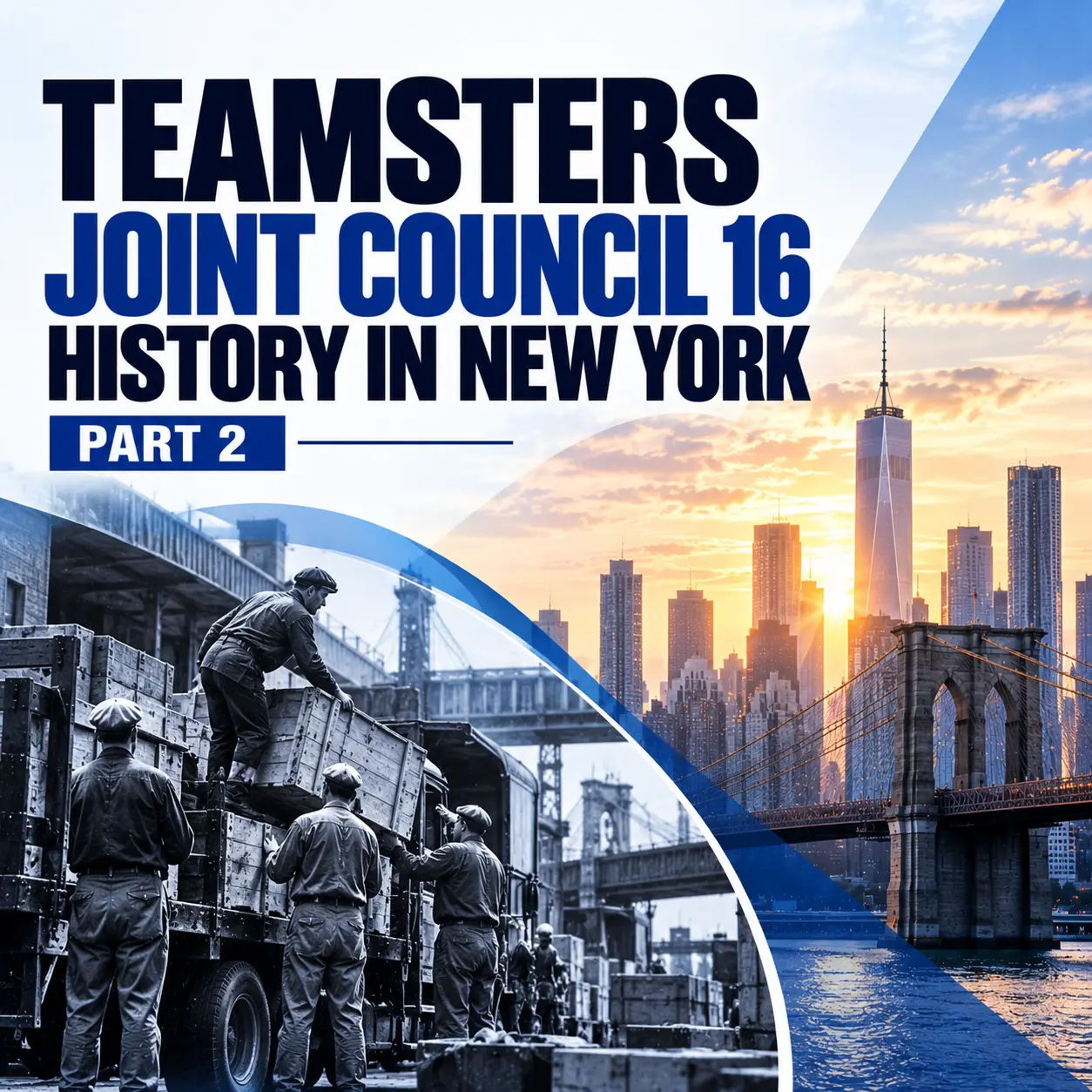
The council’s story follows the changing nature of work itself, from horse-drawn wagons and coal routes to a citywide truckers strike and a major membership milestone in 1960. Along the way, local unions built a regional body that gave Teamsters a stronger shared voice without taking away the role of each local.
Early New York Teamsters and Their Trades
New York drivers began organizing in the early 1900s because long hours and low pay affected workers across many delivery trades. In 1903, they joined drivers from around the country to form the International Brotherhood of Teamsters.
At the time, every delivery involved hard physical work. Drivers carried coal into basements and moved building materials onto jobsites, while milk and bread deliveries kept neighborhood stores supplied.
As the movement grew, individual locals gave drivers a way to organize around the specific trades and communities they served.
Teamsters Local 553 began with drivers who hauled coal on horse-drawn carts. It is New York’s oldest Teamster local, although its members now work far beyond the coal trade.
Today, Local 553 members work in oil, dairy, freight, building materials, and bakery operations. They also run the fueling operation at JFK Airport, reflecting the local’s expansion beyond coal deliveries.
How Teamster Locals Grew Across New York
Workers built local unions trade by trade so they could negotiate contracts that reflected their own jobs. These key dates show how Teamster representation expanded across New York:
- In 1903, Local 654 began serving building material drivers in Manhattan and the Bronx, while Local 60 served Brooklyn.
- In 1915, Local 282 received its charter as the Building Teamsters Union for drivers using motor trucks.
- In 1948, 1,000 Macy’s warehouse workers voted to join Local 804, bringing more warehouse work into the union.
- In 1951, city sanitation workers joined the Teamsters and formed Local 831, the Uniformed Sanitationmen’s Association.
Together, these locals gave workers a voice at the job level while creating opportunities to address issues that reached across the region.
Leadership That Connects Local and Council Work
The structure built by those early locals continues to shape Teamster leadership today. A ULA Network interview with Demos Demopoulos explores his experience in both Local 553 and Joint Council 16 and offers a look at that connection from a modern perspective.
His path into the union started early. At 11, he was helping his father on an oil truck during a blizzard, and a few years later he went to work in the oil industry himself before officially becoming a Teamster in 1978.
Over more than 40 years, Demopoulos has held nearly every position in the union, from shop steward to executive board member. He now serves as Secretary-Treasurer of both Local 553 and Joint Council 16, and in the interview he describes representing more than 2,500 members at his local and more than 110,000 across the council.
His reflections show why that connection matters to the people he represents. “I was making good money and had great benefits, better than most of my friends who graduated college,” he recalls, adding that he is proud the union can “improve the lives of not just our members, but their families as well.”
What a Joint Council Does
Joint Council 16 grew directly out of that expansion. By the early 1900s, New York already had several Teamster locals, including Local 553 and the building material locals chartered in 1903, and new locals kept forming as more trades organized. Each one bargained for its own members, yet shared employers and disputes over which local represented particular work reached across local lines.
Rather than leave each local to handle those wider issues alone, New York’s locals joined together in Joint Council 16. The council gave them a regional body for coordinating their efforts, while every local kept its own contracts and leadership.
To understand that role, it helps to know how a Joint Council works. The International Brotherhood of Teamsters explains that a Joint Council serves an area with 3 or more local unions. It gives those locals a structure for working together, solving shared problems, and settling certain disputes.
A Joint Council handles regional and interlocal matters, while individual locals continue to represent members in their workplaces.
Core responsibilities include:
- Helping locals coordinate on issues that affect workers across the same area.
- Addressing shared problems that a single local may struggle to solve alone.
- Deciding certain jurisdictional and judicial matters, including disputes over which local represents particular work and other internal union cases.
How Local Unions Keep Their Independence
Local unions handle most contract negotiations and day-to-day member needs. They retain most member dues to fund those responsibilities.
Those funds help pay for labor attorneys, accountants, business agents, organizers, and office staff. Members also choose their local leaders and vote on local bylaws, although those rules must follow the International’s constitution.
If you need help with a workplace issue, your local union is usually the right place to start. The Joint Council becomes important when locals need to coordinate or address a wider concern.
The 1938 Truckers Strike and the Shorter Workweek
That coordinated structure soon faced one of its hardest tests. During the Great Depression, New York drivers still faced low pay and long hours. In 1938, their campaign for better terms led to a truckers strike that brought much of the city to a standstill.
The council’s history says the drivers sought a 40-hour week and a higher hourly wage. Teamsters Local 282 records the specific settlement for its members: a 44-hour week with no reduction in pay.
Local 282’s account describes how strike action stopped construction across the city before Mayor LaGuardia agreed to the shorter workweek. Although the council’s history records a 40-hour demand, the Local 282 settlement provided a 44-hour week without reducing pay. Members gained time away from work while maintaining their weekly earnings.
ULA Network preserves union history through stories and interviews. If your local has records of an important agreement or members who took part in an organizing campaign, submit a story to share that experience with the labor community.
Growth Under Dan Tobin and Mike Cashel
The gains of 1938 rested on decades of steady growth, and that growth continued after the strike. Under leaders such as Dan Tobin nationally and Mike Cashel in New York, the union expanded among wagon and truck drivers. At the same time, Teamster representation was beginning to include public service work.
The council’s history, for example, includes a New York City Department of Public Welfare ambulance driver from 1922. In later years, more warehouse, factory, and public service workers joined the union.
After World War II, construction expanded across New York City and Long Island. Local 282 members transported building materials, and union wages and benefits helped support their families. As Teamster representation spread across more trades, the council continued to coordinate issues affecting multiple locals.
By the end of the 1950s, that expansion showed clearly in the council’s numbers.
The 1960 Membership Milestone
By 1960, Joint Council 16 had reached 165,000 members across 61 Teamster locals. At the same time, national Teamster membership had grown beyond 2 million.
In 1964, the National Master Freight Agreement brought 400,000 over-the-road drivers under a shared national contract. The agreement established common pay and working conditions across participating freight employers.
| Measure | 1960 | Current council figures |
| Joint Council 16 members | 165,000 | 120,000 |
| Affiliated locals | 61 | 26 |
| Examples of work | Freight, construction, warehousing, sanitation | Those trades plus public housing, airline, film, and printing work |
Later mergers explain part of the decline in the number of locals. Local 807, for example, merged into Local 553. However, that merger alone cannot explain the full change in either the number of locals or total membership.
Those figures tell part of the story, but the deeper legacy lives in what members still carry with them today.
How That History Continues Today
The history of Joint Council 16 connects early organizing efforts with the wages, pensions, and benefits members negotiate today. If your family receives support through a union benefit fund, that support forms part of a longer history of collective bargaining.
For workers considering a union career, that history can also provide context for how today’s opportunities developed. ULA Network’s guide to union trade jobs explores career paths, training, pay, and benefits across New York City. For members and families already connected to a union, resources such as our guide to how union benefit funds work offer additional context on the systems built through collective bargaining.
Preserving that history helps keep those connections visible for the next generation. ULA Network shares stories of union members, locals, and organizations through blogs, podcasts, and videos. If your local has people, events, agreements, or milestones that deserve to be remembered, talk to ULA Network about sharing their story with the broader labor community.
Frequently Asked Questions About Joint Council 16
1. What is Teamsters Joint Council 16?
Teamsters Joint Council 16 is a regional organization that brings together 26 affiliated locals representing 120,000 workers across downstate New York and Puerto Rico.
2. Which is the oldest Teamster local in New York?
Local 553 is New York’s oldest Teamster local. It began by representing coal wagon drivers, and its members now work in oil, dairy, freight, bakery operations, building materials, and JFK fueling.
3. How many Teamsters were in Joint Council 16 in 1960?
Joint Council 16 counted 165,000 members across 61 locals in 1960. National Teamster membership had also grown beyond 2 million by that time.
4. Why do Teamster locals keep so much independence?
Local unions handle most contract negotiations and help members with daily workplace needs. Keeping most dues gives them the funds to pay the people and services needed for that work.
5. What did the 1938 New York truckers strike achieve?
Local 282 records that its members won a 44-hour week without a pay cut. The settlement followed strike action that had stopped construction across the city.