Are you weighing an electrical career and torn between the union hall and an open-shop employer? Here is the number that settles most arguments before they start. Federal earnings data show union members bring home a median of $1,404 per week, compared with $1,174 for non-union workers— a gap of roughly 20 percent before benefits are included.
Numbers alone don’t tell the whole story. The real difference shows up across an entire career—from your first day of training to the day you retire.
At ULA Network, we examine the union electrician vs non union question through the unions we know best, and IBEW Local 25, representing roughly 2,000 electrical workers across Nassau and Suffolk Counties for more than nine decades, gives us a clear real-world answer. Walk through the four stages of an electrician’s working life with us and see the differences for yourself.
The Training Years: Who Prepares You Better?
Your first five years decide the electrician you become. The two paths treat those years very differently.
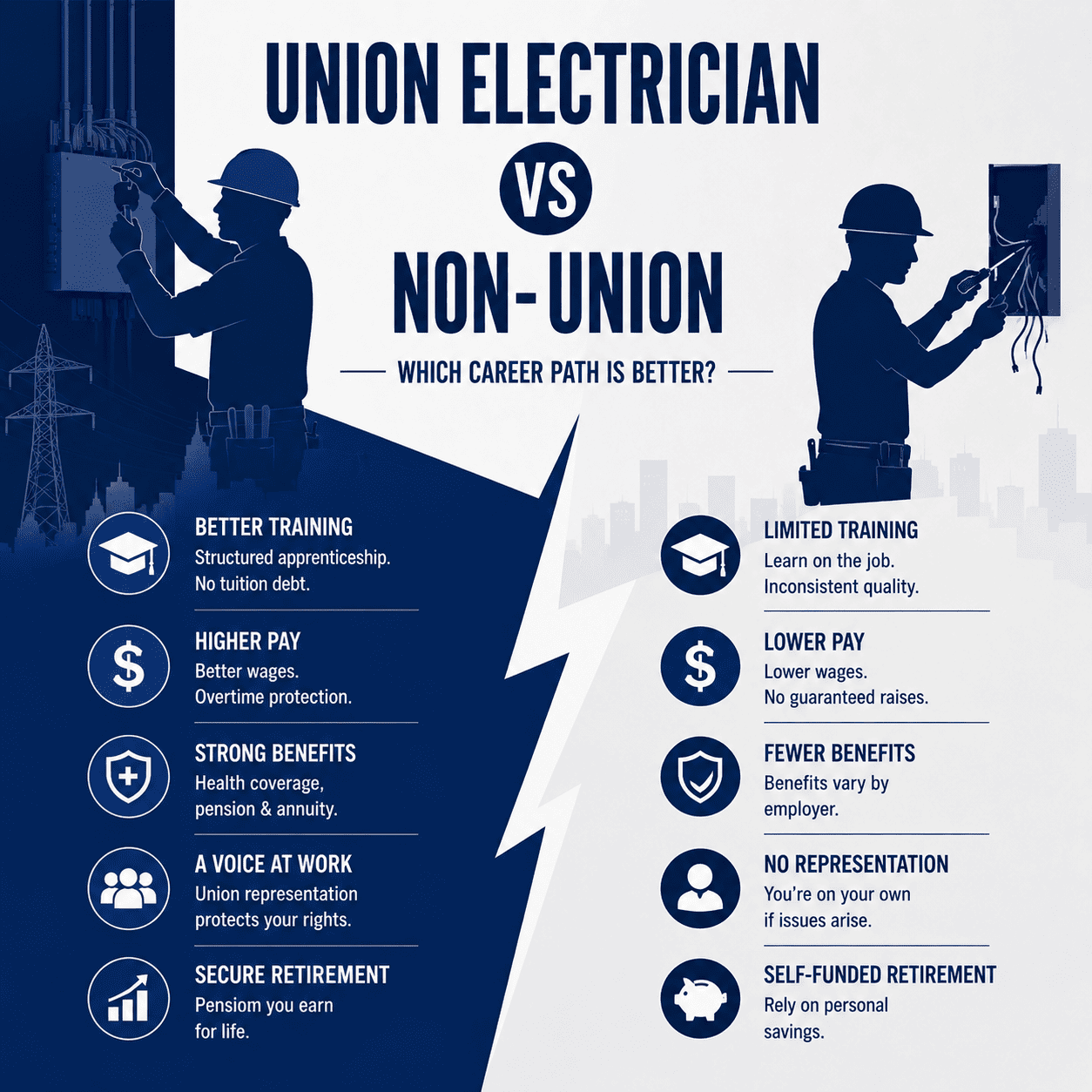
- A union apprentice trains through a structured joint apprenticeship program, with a curriculum covering code, theory, and hands-on installation.
- A non-union beginner often learns task by task, and the depth of training depends entirely on one employer’s needs.
- Union apprentices receive scheduled wage increases tied to documented progress.
- Local 25 members commit to ongoing training throughout their careers, keeping their skills current with the newest technology in the trade.
The union model also removes the tuition question. Apprentices at IBEW Local 25 finish their training without student debt, a point their leadership returns to often.
The Working Years: Wages, Variety, and a Voice
Here, the union electrician vs non union gap becomes easiest to measure. Union contracts set wage floors, overtime rules, and safety standards in writing, while open-shop terms can change whenever an employer decides.
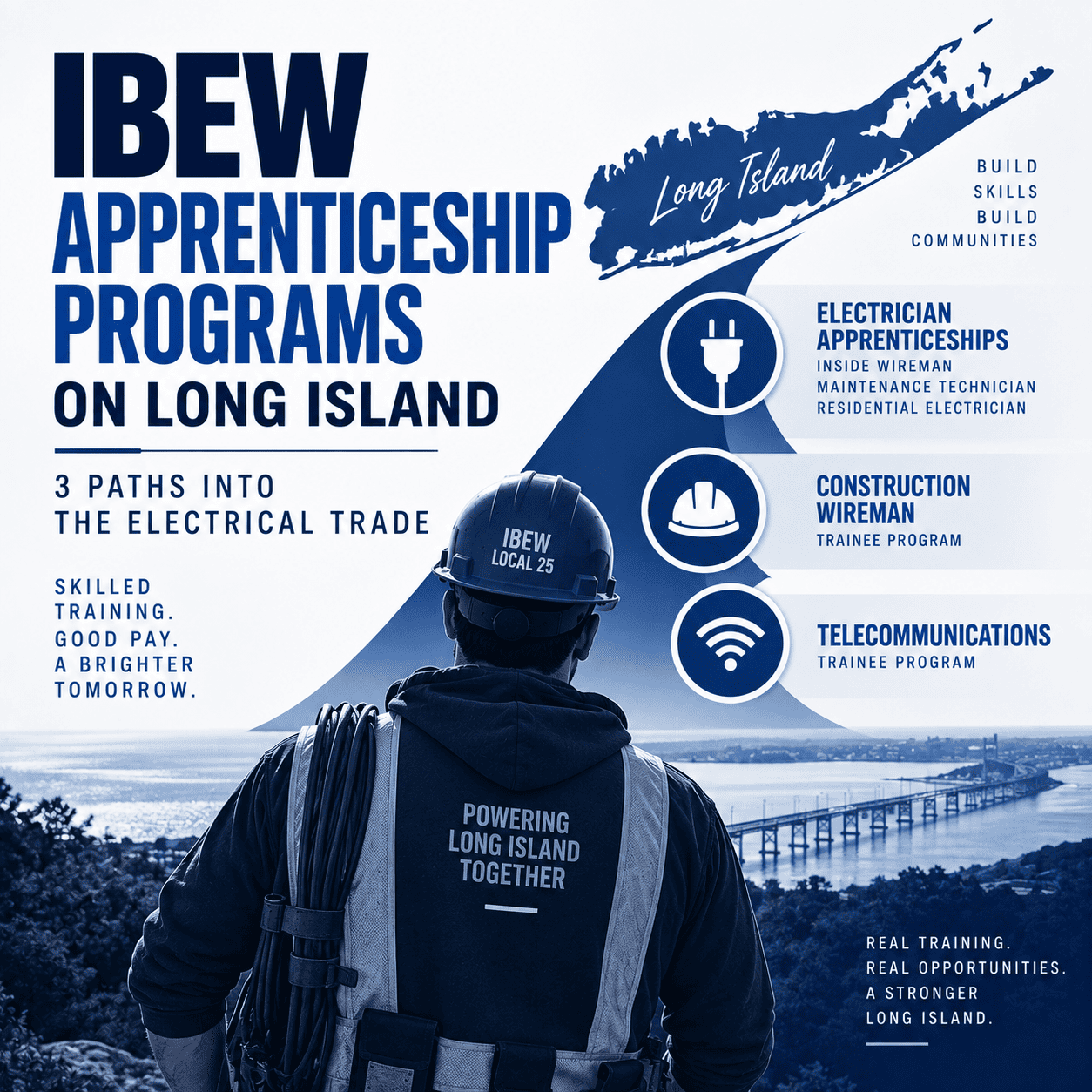
The variety of work matters just as much, because electricians remain one of the most in-demand trades in the country, with tens of thousands of openings appearing every year. Local 25 members build across the full range of that demand, and the range protects careers when one sector slows. This range of work includes:
- Commercial construction and industrial electrical systems.
- Telecommunications and data infrastructure.
- Renewable energy installations across Long Island.
- Residential wiring and maintenance work.
Steady employment is the proof. As we shared in our feature on IBEW Local 25 building careers and opportunity on Long Island, the local has maintained full employment for nearly a decade, a rare achievement in an industry known for cycles.
The Family Years: Benefits That Carry a Household
A career has to support more than one person. Union membership builds that support into the contract itself:
- Family health coverage funded through negotiated employer contributions.
- Pension credits that grow with every hour worked.
- Representation when a dispute, injury, or layoff threatens your income.
Non-union electricians can certainly find employers who offer benefits. The difference is permanence, because union benefits belong to the contract rather than to a company’s yearly budget decisions. When you change employers within the union, your coverage and pension credits travel with you, and your family never feels the gap.
The Retirement Years: Where the Paths End Up
Career Stage | Union Path (IBEW Local 25) | Non-Union Path |
Training | Structured apprenticeship, paid progression, no tuition debt | Employer-dependent, often informal |
Wages | Contract rates with scheduled increases | Individually negotiated, varies widely |
Benefits | Health, pension, and annuity secured by contract | Optional, changes with each employer |
Retirement | Defined pension plus annuity income | Mostly self-funded savings |
Retirement exposes the true cost of the open-shop path. A union electrician retires on a pension earned hour by hour, while a non-union electrician typically retires on personal savings accumulated over the course of their career.
Our Verdict: The Union Path Wins on Every Long-Term Measure
Both paths can produce skilled electricians. Only one guarantees the training, the wage floor, the family coverage, and the retirement income in writing, and that certainty compounds over a full career.
IBEW Local 25 shows what that certainty looks like in practice, with generations of Long Island families building lives through the same union hall.
We are proud to count them among the organizations we feature, and our mission at ULA Network is to help you reach opportunities exactly like this one. Explore our Local 25 coverage, and reach out to our team when you are ready to compare your options with real information in hand.
Frequently Asked Questions About Union Electrical Careers
Do union electricians really earn more than non-union electricians?
Federal data puts union weekly earnings about 20 percent above non-union earnings, and the gap widens once benefits are counted. Pension and health contributions add significant value on top of hourly wages. Union electrical rates in the New York market rank among the strongest in the trade.
How do I join the IBEW Local 25 apprenticeship on Long Island?
Local 25 recruits apprentices through its joint apprenticeship and training program serving Nassau and Suffolk Counties. Application details are posted through the local and its training committee. Our team can point you toward the right starting resources.
Are union dues worth the cost?
Dues fund contract negotiation, training, and representation, and members generally recover them many times over through higher negotiated wages and benefits. Think of dues as the operating cost of a system that protects your income. The full-employment record at Local 25 shows what that system delivers.
Can a non-union electrician join the union later in a career?
Yes, experienced electricians can organize into IBEW locals and receive credit for demonstrated skills. Many members joined mid-career after working at an open shop. The union evaluates experience and places new members at an appropriate level.
What kinds of projects do IBEW Local 25 electricians work on?
Members work across commercial construction, industrial systems, telecommunications, residential wiring, and renewable energy projects on Long Island. That project variety keeps employment steady across economic cycles. It also lets members build specialties over time.