Why This Guide Exists
Union leadership and organizers are being asked to do more with less: manage member communications, build community education campaigns, respond to press, produce social content, and track outreach — often without a dedicated marketing team. AI tools can meaningfully close that gap, but only when used thoughtfully, ethically, and in a way that strengthens — not replaces — the human relationships at the core of organizing.
This guide is designed to give ULA Network’s partner locals, foundation staff, and organizing teams a practical, non-technical starting point for using AI responsibly in labor communications work.
Part 1: Where AI Actually Helps
AI tools are most useful for organized labor communications in a few specific areas:
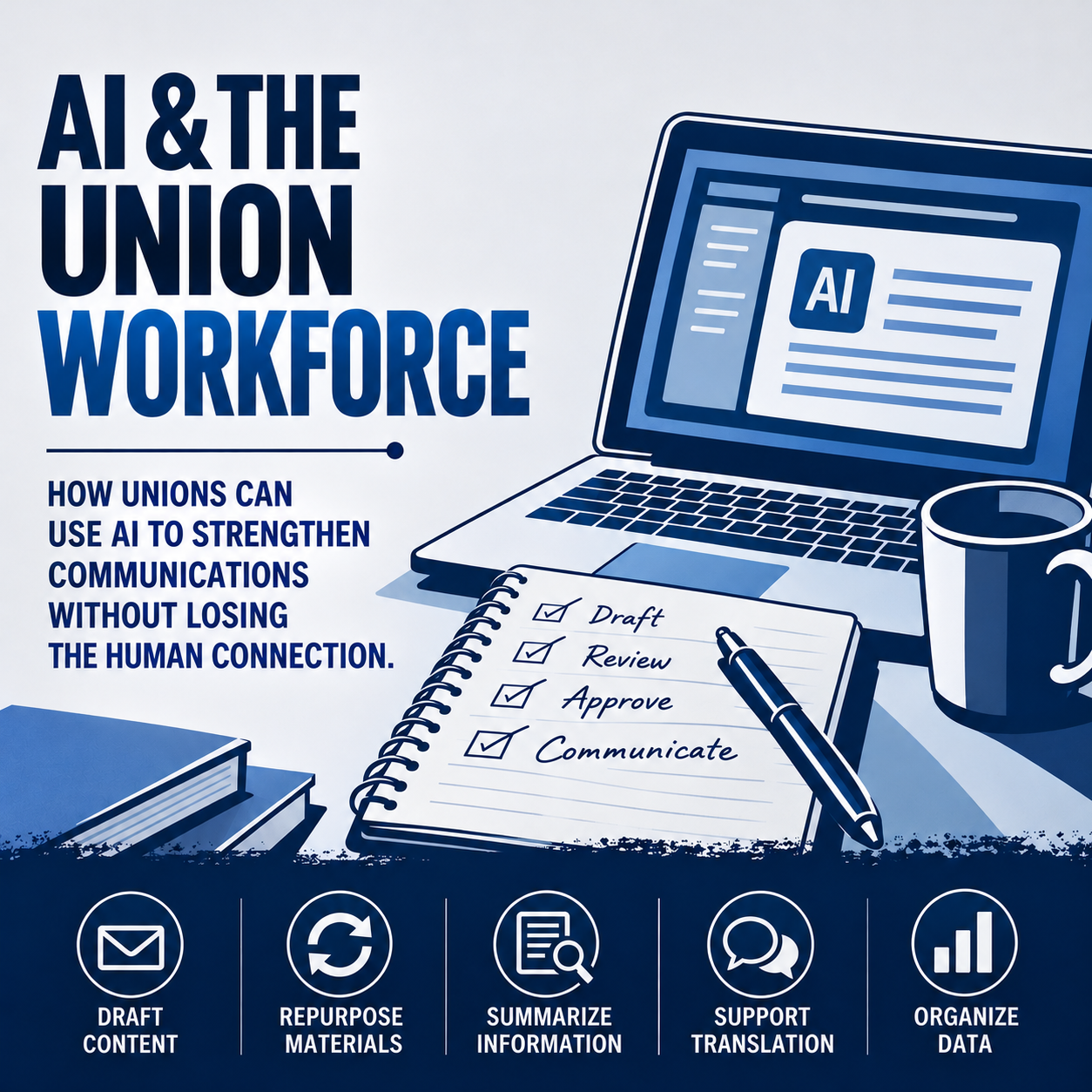
1. First-Draft Content Generation
Drafting newsletters, social captions, event announcements, and outreach emails from a set of talking points — turning a rough set of notes into a structured first draft that a human then reviews and refines.
2. Repurposing Existing Content
Taking one piece of long-form content (a speech, a press release, a member story) and reshaping it into multiple formats — a social post, a short video script, a flyer headline — without starting from scratch each time.
3. Research and Summarization
Quickly summarizing legislative updates, industry news, or lengthy documents (like contract language or grant guidelines) into plain-language briefs for leadership or members.
4. Translation and Accessibility
Helping produce accurate first-pass translations of member communications and community outreach materials for non-English-speaking members and communities — always reviewed by a fluent speaker before distribution.
5. Organizing Data Support
Helping structure and summarize outreach tracking, event RSVPs, or survey responses into readable formats for leadership review — not replacing a CRM, but making raw data easier to act on.
Part 2: Where Human Judgment Must Stay in Control
AI should never be the final voice on anything that touches trust, credibility, or member relationships. Specifically:
- Never let AI represent a position on bargaining, political endorsements, or leadership statements without direct human review and approval. AI can draft; it cannot decide what the union stands for.
- Never use AI-generated content involving real members’ stories without their explicit consent and review. Member stories are the most persuasive tool in organizing — and the most sensitive to get wrong.
- Never rely on AI for legal, safety, or contract-specific guidance. These require verified expertise, not generated text.
- Always fact-check AI output before publishing. AI tools can generate confident-sounding information that is inaccurate — especially around statistics, dates, and legislative details.
- Disclose AI-generated imagery or video when used in public-facing materials, consistent with growing expectations around transparency in media.
The rule of thumb: AI drafts, humans decide.
Part 3: A Simple Workflow for Organizing Teams
- Start with real input. Give the AI tool actual talking points, quotes, or data — not just a vague topic. The more specific the input, the more useful the output.
- Generate a first draft. Use AI to produce a structured starting point — an email, a post, a one-pager outline.
- Review for accuracy and voice. Check every fact, every number, every claim. Adjust tone so it sounds like your local, not a generic corporate voice.
- Get leadership sign-off on anything representing an official union position.
- Publish and track. Note what resonated, so future AI-assisted drafts can be prompted more effectively.
Part 4: Sample Prompts for Common Tasks
Member newsletter draft: “Draft a 300-word newsletter update for [local name] members about [topic]. Tone: direct, informative, pro-worker. Include a call to action to attend [event].”
Social repurposing: “Take this speech excerpt and turn it into three short social media captions, one for Instagram, one for LinkedIn, and one for Facebook, each under 100 words.”
Community education one-pager: “Summarize the benefits of union apprenticeship programs in plain language for a community audience unfamiliar with the trades, in under 200 words.”
Legislative summary: “Summarize this bill in plain language, highlighting what it means specifically for construction trades workers.”
Always edit AI output afterward — treat these as starting points, not finished products.
Part 5: A Note on Trust
Organized labor’s credibility has always been built on relationships — between organizers and workers, between leadership and members, between unions and the communities they serve. AI tools can help that work scale, but they cannot replace it. Every piece of AI-assisted content that goes out under a union’s name should still sound like it came from people who know the members, know the trade, and know the community — because it should.
Used this way, AI becomes what it’s meant to be: a tool that frees up organizers’ time for the work only people can do — building relationships, listening to members, and standing on a picket line or in a community meeting where it counts.