Schedules change with a day’s notice, raises stop, and managers leave safety concerns unchecked for months. If raising these problems alone gets you nowhere, how can you and your coworkers make management listen?
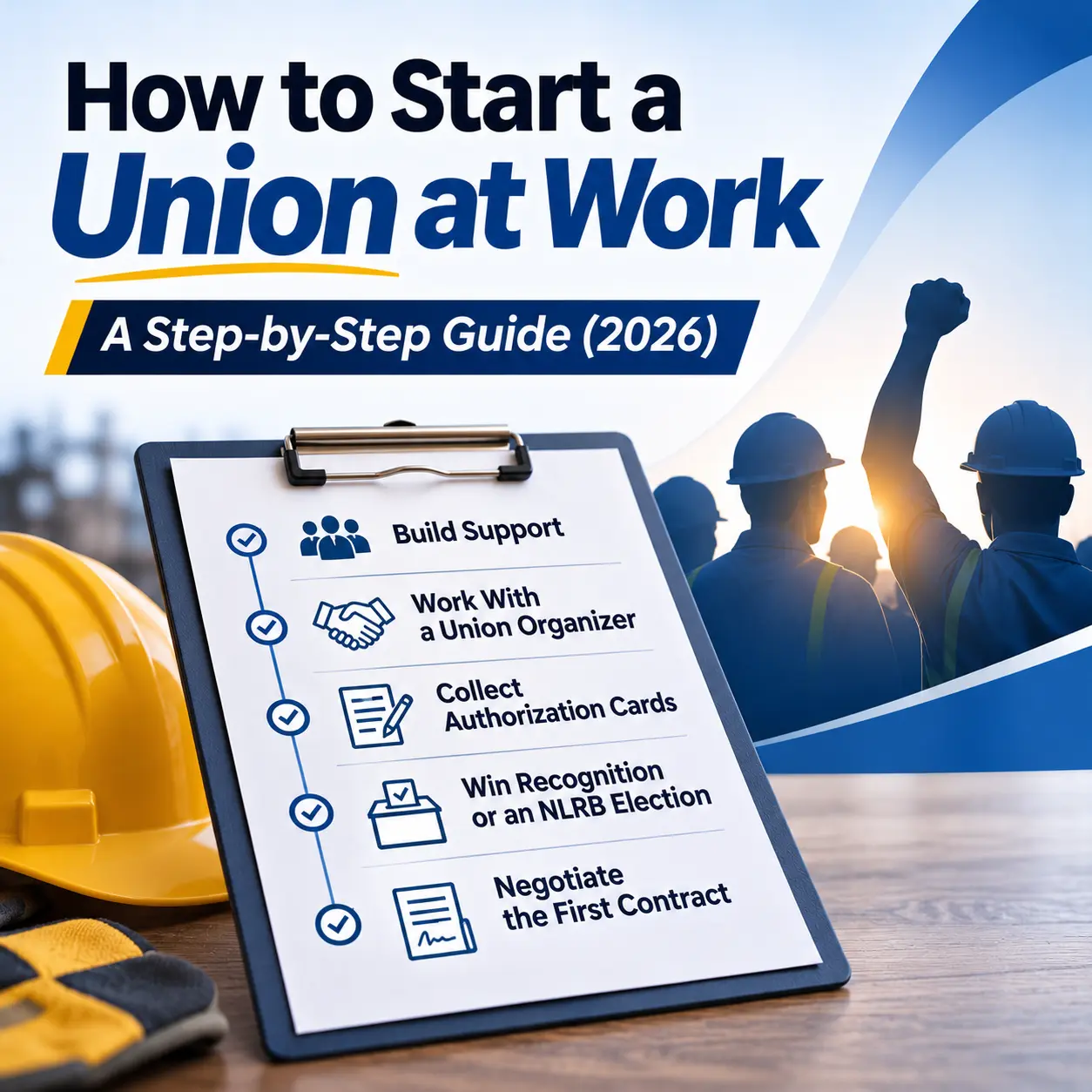
Learning how to start a union at work gives you a way to act together. Coworkers build an organizing committee and gather majority support through union authorization cards. They then seek their employer’s agreement or win a secret-ballot election run by the National Labor Relations Board.
Public support is strong: Gallup reports that 71% of Americans approve of labor unions. However, the U.S. Bureau of Labor Statistics found that only 5.9% of private-sector workers were union members in 2025. These figures cover different groups. If you want a union at work, you still need to build coworker support.
Union Representation and Eligibility
When workers organize a union, they establish a bargaining unit, the group of employees who will be represented in collective bargaining. These employees typically share common interests related to their jobs and working conditions.
Before planning how to start a union at work, check the law that covers you. The National Labor Relations Act gives most private-sector employees the right to organize. However, it leaves some workers out:
- Supervisors and managers: Job duties matter more than titles. Supervisors who use independent judgment to hire, fire, or discipline staff fall outside the Act.
- Public employees: Government workers follow other laws. In New York, the Taylor Law covers most state and local public employees.
- Other exclusions: The Act excludes independent contractors, agricultural and domestic workers, and people who work for a parent or spouse. Covered airline and railroad workers follow the Railway Labor Act.
The PRO Act proposals could change some protections, but they are not current law. If you are unsure which law applies, check with the NLRB.
Step 1: Build Coworker Support and an Organizing Committee
Many union drives start with one-on-one talks about the workplace issues people want to change. Before discussing how to unionize, listen to coworkers’ concerns.
As trust grows, form your organizing committee with coworkers whom others respect.
- Listen before you pitch: Find out what coworkers would change, so the plan meets their needs.
- Include every group: Reach each department, shift, and job title, so no one feels left out.
- Keep early discussions private: Talk during breaks when everyone involved is off duty, or meet after work. Use personal phones and email rather than company systems.
Once you know these concerns, a union organizer can help you plan.
Step 2: Work With a Union Organizer
Most workers contact an established union. Others form a union on their own, known as an independent union. When comparing your options, consider what support each union offers during contract negotiations.
- Define the unit: An organizer helps decide who belongs in the group, which shapes who can vote.
- Prepare the committee: Organizers guide you through NLRB forms and help you handle questions and pressure from managers.
As you consider your options, it can also help to understand the resources and training unions offer their members. Steamfitters Local 638 organizer Julio Reinoso shares his perspective on training in the skilled trades in this ULA Network interview.
Step 3: Collect Union Authorization Cards
Once coworkers know the plan, signed cards put their support in writing. Each card states that a worker wants the union to act for them. Read it first, so you know what you agree to when you sign.
To file an election petition, you need support from at least 30% of the proposed unit. The NLRB calls this the showing of interest. However, 30% does not make the union official or ensure a win. Organizers seek a clear majority first because support may fade if the employer pushes back.
As support grows, choose future union stewards. They help coworkers raise and resolve problems at work. The Labor Guild, a ULA Network supporter providing labor education since 1945, offers basic steward training to prepare these leaders.
Step 4: Secure Voluntary Recognition or Win an NLRB Election
With strong support in place, your group can seek voluntary recognition or request an NLRB election:
| Factor | Voluntary Recognition | NLRB Election |
| How it starts | The union shows majority support to the employer | The union files a petition with at least 30% support |
| Who decides | The employer agrees to recognize the workers’ choice | Employees vote by secret ballot |
| What it takes to win | Proof of support from more than 50% of the unit | A majority of valid votes cast |
At this stage, employers may send letters, hold meetings, or hire outside experts to oppose the union. These efforts to discourage unionization are commonly known as union busting. Employers can share their views, but NLRB rules ban actions such as:
- Threats: Managers cannot threaten to close the workplace or cut benefits because workers support a union.
- Coercive questioning or surveillance: They cannot pressure workers with questions about union activity. They also cannot spy on union efforts.
- Promised rewards: Employers cannot offer raises or perks to get workers to vote against the union.
If employers fire them for union activity, workers should contact the NLRB promptly. You generally need to file a charge within 6 months. Keep messages and dates to help explain what happened.
Step 5: Negotiate the First Contract
Once your union gains recognition, it can bargain for the group. That alone does not set new wages or benefits. Your bargaining team must seek terms that meet coworkers’ needs.
The employer and union must take part in collective bargaining in good faith, though the law does not force either side to agree to terms.
BLS reports median weekly earnings of $1,404 for full-time union members in 2025, compared with $1,174 for nonunion workers. The groups also differ by job and industry. These figures do not promise you a set raise.
A first contract can take a year or longer. Members need to know how talks progress during that wait. For updates across shifts, the Union Strong Appoffers unions a private communication channel across jobsites.
Build a Union Organizing Plan
Knowing how to start a union at work helps you act on concerns that coworkers share. Start with people you trust and check your rights. Then build support, so your group can seek recognition with a clear plan.
To help your committee plan, explore our workers’ rights education at ULA Network.
Frequently Asked Questions
1. How Many Coworkers Do You Need to Start a Union?
An NLRB bargaining unit generally needs at least 2 employees. To request a vote, at least 30% must sign cards or a petition in support of the union.
2. Can You Be Fired for Trying to Start a Union at Work?
Federal law bans firing covered workers for protected union activity. If this happens, report the possible unfair labor practice to the NLRB promptly.
3. How Long Does It Take to Form a Union?
If you are learning how to start a union at work, building support can take weeks or months. First contract talks can then take a year or longer.
4. What Happens If the Union Loses the Vote?
Federal law generally bars a new vote in the same unit for 12 months after a valid election. Meanwhile, your committee can rebuild support.
5. When Do Workers Start Paying Union Dues?
Many unions wait until workers approve their first contract to charge union dues. However, each union sets its own rules. Check the cost and start date before you join.